Monday, 1 June 2015

A Mexican twist on a Maltese Favourite

Something that every little Maltese girl is likely to tell you, is that her Nanna (grandmother) makes the world's best Ross Fil-Forn (Maltese for baked rice). This was certainly true for me - my grandmother makes the tastiest, most moist and cheesiest baked rice I've ever eaten. And although Baked Rice was one of the first Maltese dishes that I learnt how to cook when I started university, I've never been able to get anywhere close to replicating Nanna's ability. And even now, I'm put off making this super tasty dish because boyfriend complains about it being boring and rather tasteless. Not something someone who has slaved away in the kitchen all day likes hearing.

So recently I decided that I felt like making Baked Rice but, with these thoughts in mind, I also decided that it needed a distinctly flavourful twist to it. And that's when I came up with the idea of creating a Mexican-style chilli con carne Baked Rice. All the greatness of Maltese cooking, with a spicy Mexican twist.

The recipe below describes how I made this but, if you don't want to follow the Mexican route, you can make the Maltese version of this by simply not putting any of the Chilli spices into the original sauce. But to all you Maltese out there, I definitely recommend giving it a try. It comes delicious!

A Myriad of Spices 
Chilli con Ross Fil-Forn
(see what I did there?)

Chilli con carne sauce:

minced beef
onion
garlic
HP sauce
chocolate powder
mixed herbs
paprika
cayenne pepper
cumin
turmeric
Cinammon & Cayenne Pepper - a miracle combo
ground cinnamon
carrots
kidney beans
chopped tomatoes
chilli peppers

Other ingredients:

white rice
two eggs
grated cheese (cheddar will do)


Method

First make the chilli sauce. Add chopped onions to a hot saucepan with oil in it, and sauté until soft. Add garlic, chilli peppers and then minced beef, stirring until all the mince is browned. Add about a tablespoon of all the spices (a bit less in terms of turmeric and cinnamon). Also add a table spoon of chocolate powder (just do it! trust me!) and a squirt of brown sauce.

Onions, garlic and chillis - the most delightful smell
Mix these all together, then add the carrots and chopped tomatoes. Mix and bring to a boil before letting it simmer for a while. This would be a good point to give it a taste and see if any further spices are needed (I like my chilli to have a powerful depth). Add some seasoning, the kidney beans, stir and allow to cool.

Chilli sauce completed!
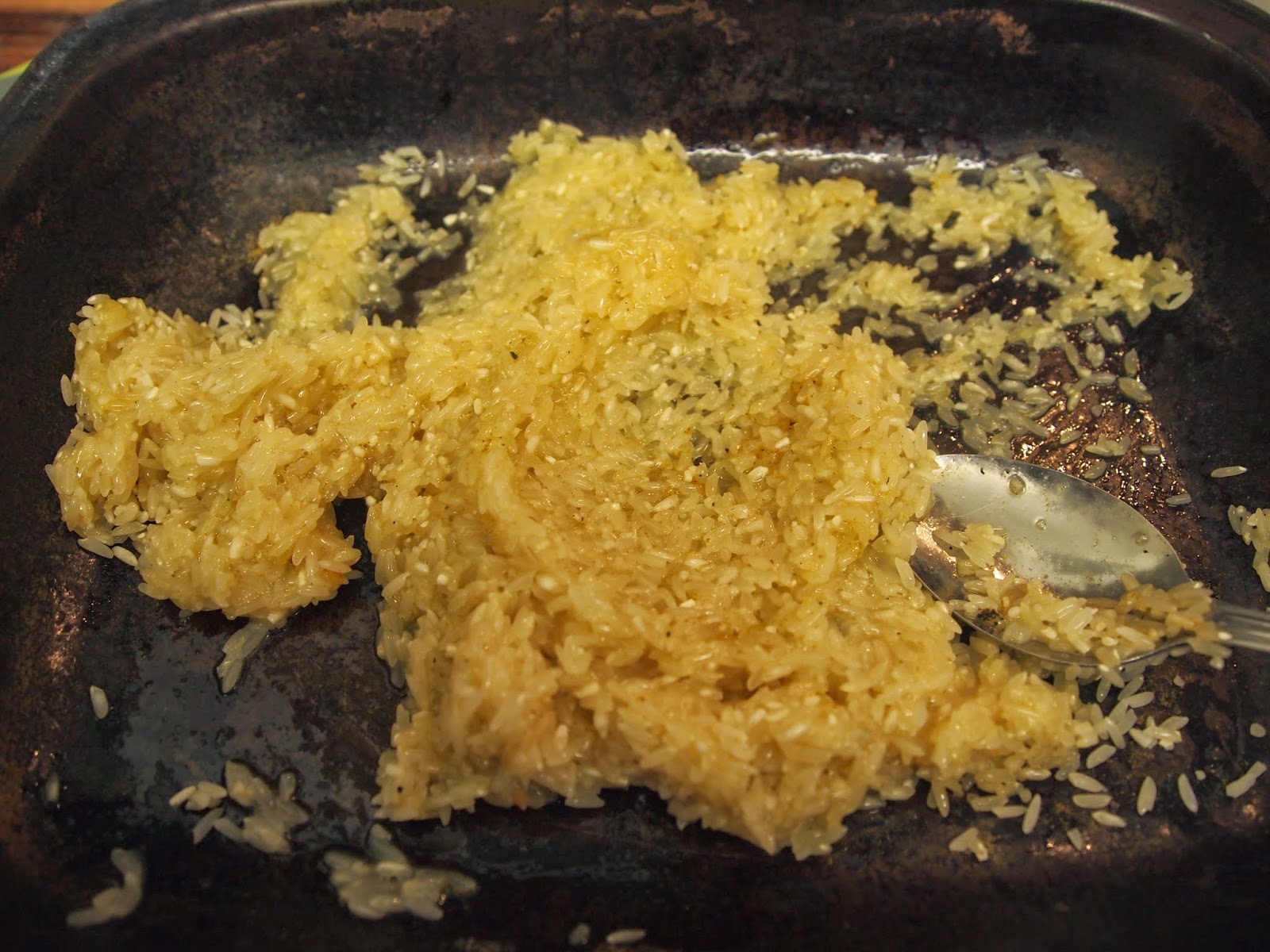
While the sauce is cooling, put the rice in a deep baking dish. Add the eggs and whisk, making sure they are fully integrated with the rice. This is important, as the egg causes the dish to solidify, rather than remaining a soggy mess of chilli sauce and rice. 


Rice, with a dash of cinnamon

Rice mixed with egg
After the egg has been mixed in, add some cold water to the dish. This is needed for the rice to cook properly and prevent the dish from drying up.
Looks a bit weird at this point, but needs be done
Finally, add the chilli con carne sauce to the mix, and stir until properly combined. Then grate half the cheese over the dish, stir it in, then grate the rest of the cheese over the top. This is now ready to go in the oven at about 180 degrees celsius.

Sauce all added - beginning to look more consumable!
Pre-oven
After about half an hour, it is recommended that you get the dish out and stir it through again to mix the heat around. It should be solidifying by this point but you should still be able to stir it fairly easily. Leave it in for about an hour total and then allow it to cool slightly before serving up. And trust me, it will be worth the wait!

And after this, boyfriend has never complained about my Ross Fil-Forn again!


An hour later, golden and delicious

Bon Appetito!


Sunday, 24 May 2015

I knew mum was good for something...

I have very fond memories of my mother in the kitchen, even if those memories do not stretch to the results of her time in there. Mummy has become a better cook with time, but as a child I recall her preparing me overcooked (boiled) veggies and meat that I found impossible to chew. I have no doubt that my recollections are unduly darkened due to my being an impossibly picky child, but nevertheless, there were very few things that I remember my mother cooking that I actually liked.

One exception to this was her breaded chicken, which I remember very fondly. She would cover chicken breasts in flour, dip in egg and then cover in breadcrumbs, before sealing them off in a frying pan and then finishing in the oven. I used to love these, but surprisingly this dish is not something I've cooked very often in my adult life.

Until the other day however, when I had brought some turkey steaks out for dinner and was struggling with what to do with them. After all, there are only so many times I can eat a stir fry. The idea popped into my head as I was poking about the fridge and found that I had plenty of eggs, and I also just happened to have some slightly stale brown bread in the bread bin. So decision made - turkey schnitzel for dinner, with mediterranean egg fried rice on the side. For real! Here's how I went about this incredible simple yet messy recipe.

Turkey Schnitzel + Mediterranean Egg Fried Rice

Schnitzel

Turkey steaks
stale brown bread
mixed herbs/fresh thyme
eggs
flour

Mediterranean rice

brown rice
peppers
onions
thyme
green beans
sundried tomatoes/fresh tomatoes
carrots

Method

Lay out three plates. In the first, put flour with some seasoning and mixed herbs. In the second, crack two eggs and whisk. In the third, put blitzed brown bread breadcrumbs, with seasoning and chopped thyme.

Egg and flour plates

Get out the turkey steaks and wrap in cellophane. Grab a rolling pin (or a meat hammer if you're lucky enough to have one), and gently hit the turkey steaks until they're pretty flat. Remove the cellophane, and get a frying pan on the heat with some oil in it.

Bashed turkey steaks
Before starting to cook the turkey, get your rice on the boil. You ideally want to have it done five minutes before you cook your turkey.

Place the turkey in the plate with the flour, and coat thoroughly. Then put it in the eggy plate and also coat thoroughly. Repeat with the flour and egg, so that the turkey has a nice double layer of both. Then put your steaks in the breadcrumb mix, and cover as thoroughly as possible. Then place your steaks in a hot frying pan, and the rest is easy. They won't take long to cook through, but won't dry out because of the various coverings.
Turkey schnitzel - just about done
Once the rice is cooked through, drain and keep it on the side. Heat some oil in the same saucepan, and add the chopped onions, peppers, carrots and green beans. Stir whilst cooking for a couple of minutes, then add the rice, the leftover egg and breadcrumbs, herbs and tomatoes. Keep stirring until the egg is cooked through and serve up. Yum yum!


The final product - so tasty!!

Monday, 11 May 2015

Seafood Paella on the Fly

I tend to cook with whatever ingredients I have in the house, rather than plan things in advance. This was certainly the case the other day when I came home from work and was rather stumped for what to cook.

I still had a bunch of chorizo in the fridge leftover from some previous meal, so the obvious choice was some sort of Spanish dish. My freezer is always chock full of salmon and shrimps, so I decided to go for a seafood paella. Nothing fancy, but it turns out super tasty. Here's the recipe, and feel free to substitute ingredients if you're missing anything. Also, don't feel shy about adding more and different varieties of seafood - they all work.

Smoked Salmon and Shrimp Paella

Smoked salmon fillet (freezer)
Shrimps (freezer)
Leeks (freezer)
Chorizo
Onion
Chillies
Garlic
Carrots
Plum tomatoes
Asparagus
Bell peppers
Rice
Chicken stock
Olive oil
White wine glug

First, chop everything up as required. I like to have everything laid out on the chopping board so that there's no stress later on in the cooking process

All chopped and set to cook
Heat some oil in a non-stick saucepan. Add chopped onions and leeks and stir until softened.
Onions and leeks softening
Add the garlic and chorizo. After the chorizo begins to let out its oils, add the rice and stir to coat in all the oils. Add that glug of white wine and let that absorb into the rice, then add some boiling water/stock slowly, as if you're making a risotto.
Look at all that red oil from the chorizo
Keep stirring and keep adding your water/stock, slowly. The rice will soak up the liquid and cook. Add in your carrots as they need a bit more cooking time than the other veggies.
Once the rice is almost fully cooked, add the asparagus and peppers. They don't need long to cook. Then add the tomatoes, which will give a lovely tang to the mixture.

Rice and carrots - keep stirring!
Finally, throw in the shrimp and fish and keep stirring until they're just cooked. Then plate up, and drizzle some olive oil over the top. The sheer smell will make you drool!

Adding stock makes it look a bit soupy, but the rice will soak it up

Dinner is served!


Monday, 4 May 2015

Halloumi for lunch, with a Spanish twist

I tend to be a bit hungover on Saturdays, typically a result of heading to the pub after work on Friday and forgetting to have dinner. Which sometimes leads to overindulgence at the takeaway on the way home and hence my wanting something a bit healthier for lunch on Saturday.

Last Saturday was no different. So come lunchtime I raided the fridge to see what vegetables and yummy treats I could pull together for something tasty for myself and the boyfriend. And this is what I came up with: a halloumi, chorizo and potato salad. Delightful. Here's the recipe:

Halloumi, Chorizo and Potato Salad

Lamb's lettuce, rocket and fresh baby spinach
Fresh cherry tomatoes
Potatoes (preferable new but whatever is hidden in the cupboard will do)
Green beans
Chorizo sausage
Halloumi cheese
Olive oil
Walnut oil

Wash and chop the potatoes, skin still on. Place in a steamer for ten minutes, until cooked through but still fairly solid. Don't overcook!

Add the washed and chopped green beans to the steamer, shortly before the potatoes are done. They don't need long.

Chop the chorizo and toss into a frying pan. No oil - they're oily enough. After those essential oils have entered the pan, add in the halloumi wedges.

In the meantime, construct the salad. Place the salad leaves in a bowl, add chopped tomatoes, then add the steamed potatoes and beans. Next add the chorizo and the halloumi, some fresh pepper, then a drizzle of oil. Top off with a drizzle of walnut oil (or even chopped walnuts if you've got the real deal).

Done! A quick and healthy(-ish - the chorizo ain't great) lunch!!


Monday, 27 April 2015

How to live without Maltese bread

Let me let you in on a secret. You can't. Once you've tasted proper Maltese bread from Gharghur, no other bread will ever match up. And forget making it at home, because it's all about the oven!! There's something about those massive stone ovens that you see in all the bakeries in Malta, that bakes the bread in an incredible way that imbues them with a distinct flavour that I've never been able to replicate. I think it's to do with them never being cleaned...that way flavour can be passed on from generation to generation of bread.

Ok...I know it's not actually the ovens that do all the work. Maltese bread is so fabulous because it's a type of sourdough, made from a starter (natural yeast) that has been built up over years and years. Flavour comes from the development of the yeast over time, and apparently different bakeries throughout the country have their own 'secret recipe' starter - hence the different varieties of Maltese bread.

So how do you make a starter? It's pretty simple, and I recommend Paul Hollywood's version if you want to try it out yourself. But be warned, it takes a while to develop a good starter, and it will die a death if you neglect it for more than a few days. I suppose you can say that it's worth it if you really miss Maltese bread, but I have an alternative solution.

If you need a sourdough...go to the supermarket - they sell it there. It's nothing like ftira but it is really tasty and makes great toast.

What I can recommend, it you want to make delicious bread at home, and you want something a bit more exciting than a white loaf, go for ciabatta or olive&rosemary focaccia. They're absolutely my favourite and rather Mediterranean. Here's the recipes:

Ciabatta

500g strong white bread flour
380g water
15g yeast
12g salt
10 tbsp olive oil

Mix half the flour with all the water and half the yeast. Leave for half an hour or until the yeast has clearly activated and created some bubbles in the mixture

Combine the rest of the ingredients with the initial mixture. Knead (or use the dough hook on your mixer) until the gluten has developed and the dough is super elastic and stretchy

Place in an oiled bowl and cover with cling film, and place in a warm place. Leave for six hours or overnight if possible. It should rise by a substantial amount.

When risen, tip onto a flour surface and shape, handling it as little as possible. Try not to let any air escape from the dough, as all those air bubbles are what make it so beautifully ciabatta-like.

Place on a floured baking tray, and put in a 200C fan pre-heated oven, for 45 minutes, and then lower to 180C for another twenty minutes.

Place on a wire rack to cool. Et voila!

My first, and certainly not last attempt at ciabatta. I think it looks quite rustic


Olive & Rosemary Focaccia

500g strong white bread flour
380g water
15g yeast
12g salt
10 tbsp olive oil
many olives (green, black or both)
much rosemary

As above, create a starter allowing the yeast to activate, and then add the rest of the flour and yeast, the salt, the chopped olives and two tbsp olive oil

Leave the dough to rise until double its original size and then knock back on a floured surface. Place the dough on a floured baking tray and flatten out across the tray. Use your fingers to make dimples in the dough, stick rosemary into the dough in random places and drizzle with oil

Leave to rise for a further half an hour and then place in a 150C pre-heated oven until golden-brown (about 40 minutes). Leave to cool on a wire rack.

Olive and rosemary focaccia. I put some sea salt on the top before cooking, and more olive oil post cooking


Monday, 20 April 2015

A Review of Maltese Cooking II

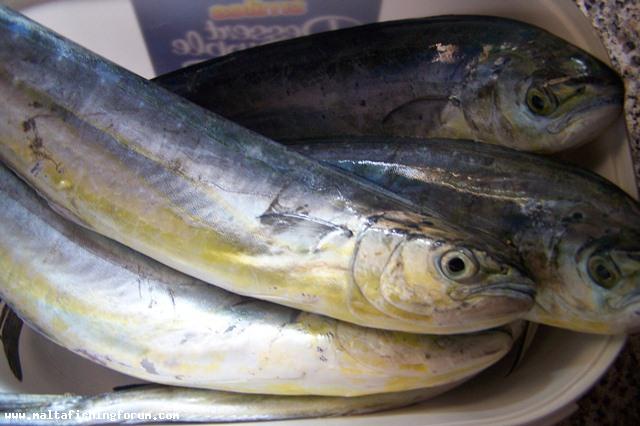
So picking up where I left off the other day with a bit more insight into traditional Maltese cuisine: fish. I love going to the fish market in the fishing village of Marsaxlokk early on a Sunday morning, and picking up some beautiful super fresh fish for dinner. You have to know what to pick out, but you're usually safe with fish that you know is Mediterranean. I love finding beautiful, thick cut tuna steaks, and cooking them on the BBQ with nothing but a little brush of olive oil. But if you really want to go the traditional Maltese way, you'd pick up a lovely fish called the Dolphin fish, or lampuka and turn it into lampuki pie. I'll get round to putting a recipe for that on this blog at some point in the future.

fresh lampuki
lampuki pie
And of course there's plenty of other fish that you can pick up super fresh from the market. They are always salt-water fish, because as you all know, the Mediterranean is filled with salty sea water, and we have no rivers or lakes in Malta to pick up fresh-water fish. Here's a great list of all the fish that can be found in the Mediterranean, including their English and Maltese names. Cerna (or grouper) makes for a handsome meal, and Dentici (Dentex) and Dott (Wreckfish) are also popular with the Maltese. BBQ them, fry them, bake them, make Aljotta (fish soup) - we do it all! Yum!!

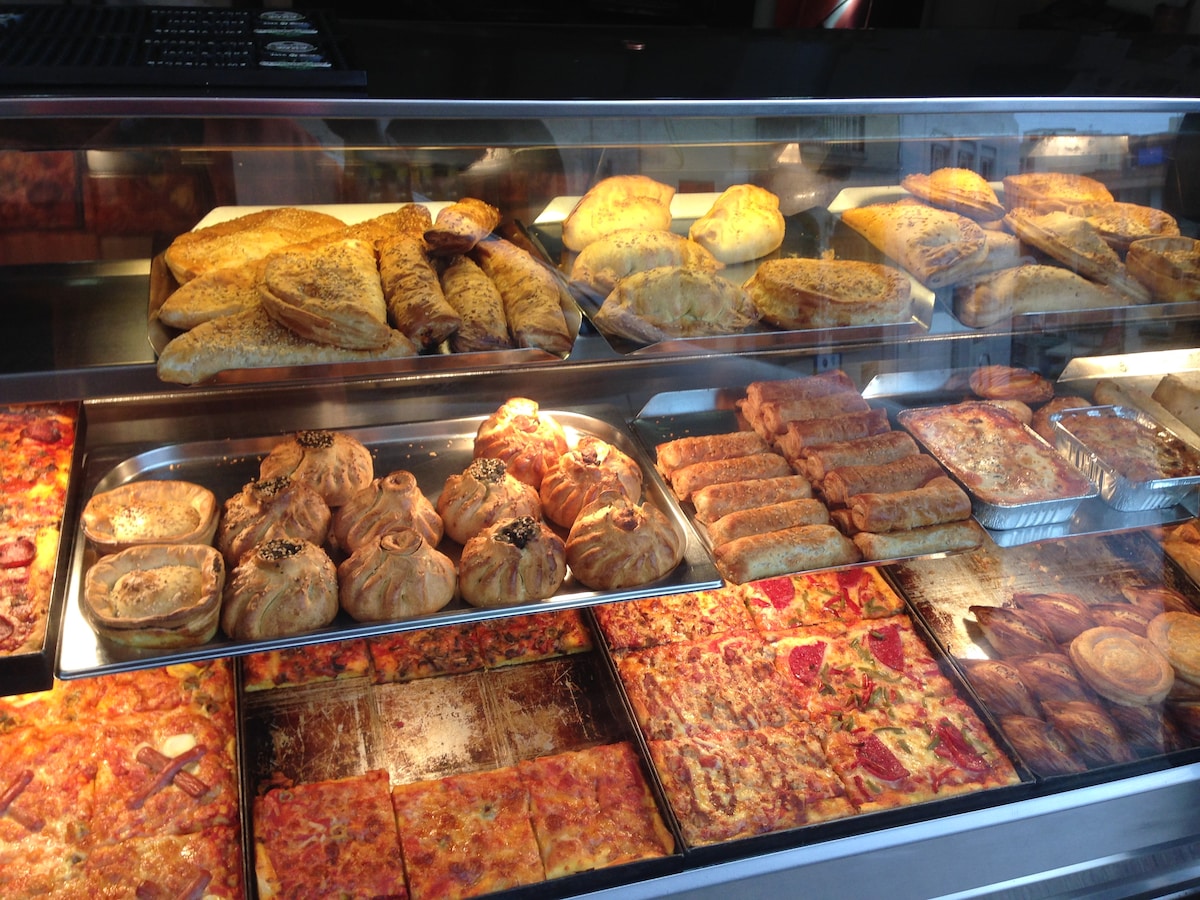
Let's move on from fish. One very popular thing in Malta is the alternative to the chippy. We call it the pastizzeria and no, it absolutely does not sell fish and chips. It sells Maltese baked and fried savoury pastries and other snacky items. They're very cheap. They're totes delicious. And some of them have more calories than you can imagine!!

So what are pastizzi? Image cornish pasties, but oval or triangular shape, made of filo pastry, and filled either with mushy peas (pastizzi tal-pizelli) or ricotta cheese (pastizzi tal-irkotta). They are extremely popular in Malta, and amazingly delicious. And they only cost about 20 cents each!! The downside is they are both addictive and high in calories so you need to steer clear of them when on a diet.

pastizzi
Other items obtainable from the pastizzeria include square slices of pizza, usually either margherita or with tuna and olive toppings. They have little trays of imqarrun or ross fil-forn (see my previous blog post for a description of these). They've also got more traditional items, such as little pies, sausage rolls and other such items that you find in Greggs here in the UK. But pastizzi are certainly their top sellers.

The local pastizzeria

I've given a pretty hefty overview of some favourite tasties in Malta now, but of course I've barely made a dent, as Maltese food has so many varieties and flavours that it would be impossible to cover them all.  However, I would class any meal as a Maltese or Mediterranean dish as long as it has most of the following characteristics:

-tomato based
-fresh meat or veg as the main ingredient
-high in flavour, with herbs, olives, capers, garlic and good quality olive oil contributing highly

Further examples of such dishes are the Maltese Kapunata (essentially a ratatouille) and Soppa ta l-Armla (Widow's Soup), filled with the delicious Maltese cheese gbejna. I promise to present the recipe for this one very soon!

Which brings us to the end of my whirlwind tour of Maltese food. Next time, I'll start talking about how I bring my Maltese personality into the British kitchen, to make the most delicious meals I can imagine.

Monday, 13 April 2015

A Review of Maltese Cooking

Before I start overwhelming you all with my delicious sounding and ever so unusual Malt-British recipes, I thought I'd give a quick overview of the typical kinds of foods found in a Maltese kitchen, and in Malta in general. Some of these dishes may sound quite typically Italian, and some may have a more Moroccan or Arabic twist, and some may just sound weird, but trust me - they're all delicious.

When thinking about Maltese food, I always begin with Maltese bread, or hobza Maltija. Although 'normal' white bread can be bought in Malta, we prefer our traditional bakers and the uber fresh bread that we get from them., often still warm. Maltese hobza is a sourdough, which means that each baker has a unique flavour associated with their bread. The bread is extremely crusty, and comes in two main varieties: one which can be cut into slices and the other which is known as ftira and is used to make the unique Maltese sandwiches. Both types are absolutely delicious, and I have no doubt that many of the chunkier Maltese locals will attribute their weight to the copious amounts of hobza that they have eaten before, during and after their meals all their lives.


From hobza we naturally move onto hobz biz-zejt (hob-zz biz zeyt) which translates literally into bread with oil. But it is so much more than that. We like to make up a mixture of stuff that we place into the bread, usually a combination of kunserva (tomato paste), fresh chopped tomatoes, capers, olives, salt, pepper, copious amounts of olive oil and sometimes canned tuna. Everyone has their own version of this mixture (or tahlita) and it is the most divine thing you can imagine. Give it a go - I had hobz biz-zejt for lunch every day of my childhood, and I would still if I could get my hands on some fresh hobza on a daily basis.

My own version of Hobz biz-zejt

All this talk of hobz biz-zejt is making me salivate so it's time to move on. Next I'm going to describe a traditional Maltese fenkata, which means rabbit feast. This is a very traditional local way of eating that goes back years, and it's so much fun to go out to restaurants in some of the small villages with a big family or a group of friends, and stuff yourself in this way.

At the beginning of a fenkata, you start with olives, hobz biz-zejt, more fresh bread, and bebbux (beb-boosh), which are snails cooked in garlic and butter. Yes, snails. Divine. Freakin' love them!! After this we move onto the starter, which is always pasta. You can either have spaghetti or ravioli filled with ricotta, traditionally served in a rabbit sauce. Then, in case you're not already full, the main course comes out.

The main course is obviously rabbit, and this can be cooked in two ways: as a stew or fried in garlic. The latter is, of course, my favourite way, and it is so flavoursome. You can't be a lady when eating rabbit, because there's lots of bones (and the head for the strong of heart), but it is so tasty that it's worth dripping rabbit juice down your fingers. The rabbit is served with thick-cut Maltese chips, and that's it!! No nasty vegetables at a fenkata - there simply isn't space to fit any in!

Rabbit stew
Finally, to finish the evening, they bring out peanuts in their shells (karawett) and helwa tat-tork (sugary mixture of crushed almonds). Some people even have space for mqaret (minced dates in pastry) with ice cream, but I certainly never do. By then, you've drunk the rest of the wine or beer (Maltese cisk is a local lager and I recommend you try it - yum!) and it's time to roll yourself home!

If rabbit isn't for you, there are plenty of other options to eat at a fenkata. You could have something relatively low key (they always serve chicken as an option), or you could go for another old favourite: horse stew!! Not easy to find, but there are a few select places on the island where they serve this up, and it is sooooo good!!

Fried rabbit, with lots of garlic
Let's move onto something a little less unusual. The Maltese don't actually dine on rabbit super regularly, so we do have a few more normal dishes. Baked rice (ross fil-forn) and baked pasta (imqarrun) are two very popular dishes, especially with children. I won't describe them in more detail here, since I will certainly be cooking them in the near future and will give the recipes in future blog posts. But *spoiler*: they are nothing like the rice/pasta bakes found in the UK!

imqarrun

Now, what kind of Mediterranean cuisine would be complete without fish and seafood. The Maltese bring in plenty of local, fresh fish all the time, and there is quite the appetite for prawns, calamari and octopus. I can't think of any specifically Maltese way of presenting these, although spaghetti with an octopus sauce is a firm favourite, but you can bet that fresh tomatoes, capers, olive oil and the like are commons ingredients served with the fish.

I'm going to bring this blog post to an end now, as I don't want to drive you all to a madness beyond control, caused by the description of all this tasty food. Go away, make yourself some hobz biz-zejt, and come back tomorrow for a description of Maltese fast food (unlike anything found elsewhere), and some Maltese desserts. I'll also tell you about some popular veggie dishes which draw influence from many countries, but all with the standard Maltese twist.